
The Yielding Mother: Why we cannot control motherhood
Navigating the rupture of trying to control motherhood through psychology and mythology

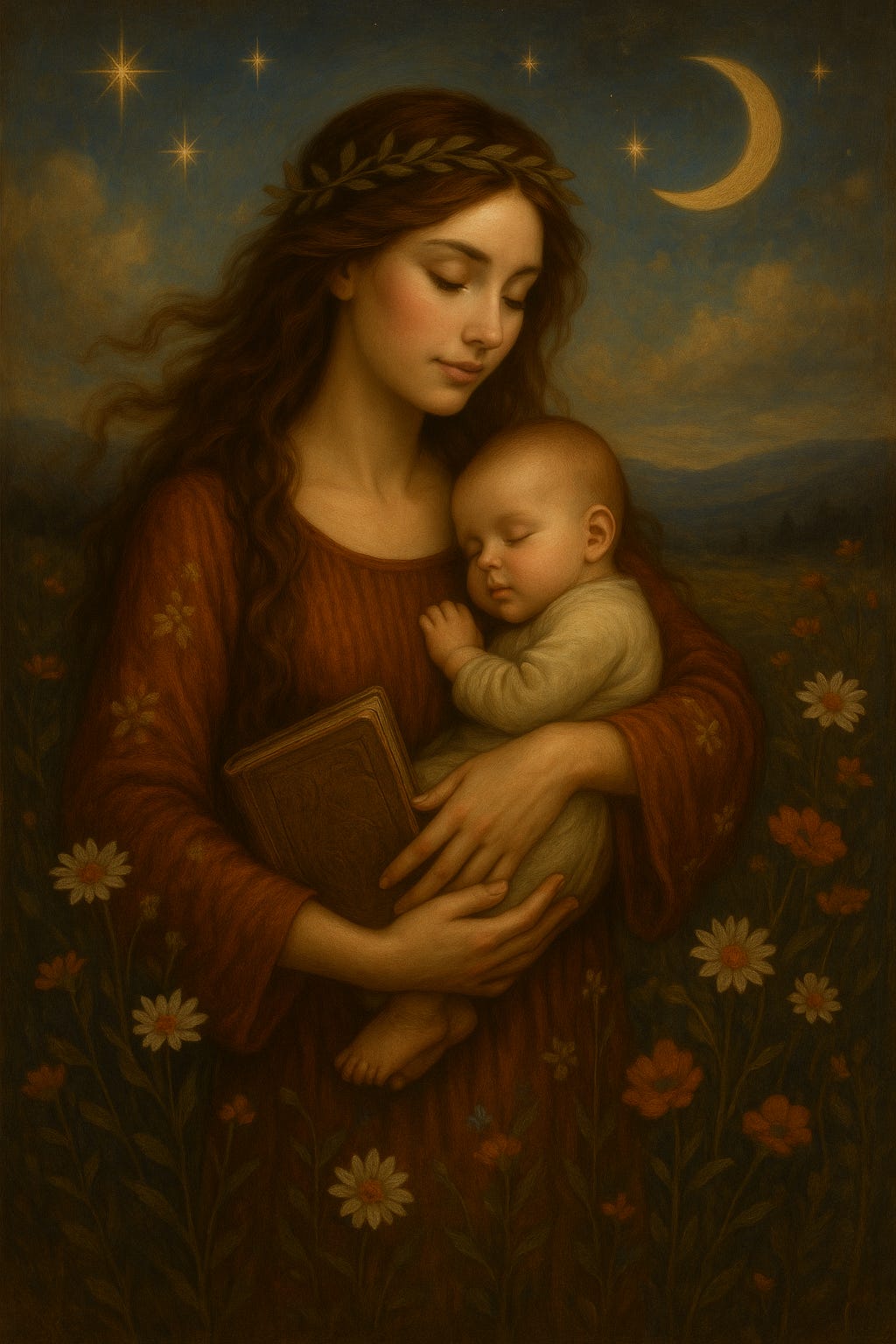
Motherhood humbles us. It dismantles the fantasy that we can hold everything together, if only we try hard enough. From the moment we fall pregnant, the limitations of our control are exposed: our bodies change without permission, births spill us open, children arrive with their own personalities and agendas.
For me, birth shattered the illusion of control completely. In that threshold, we are asked to surrender - or we stall. Either way, we are changed.
Yet, still, we reach for control.
In the old stories, the yielding mother teaches us that the grasp must first loosen for transformation to begin. Our ancestors understood the psychological architecture of yielding control in motherhood long before psychologists gave it language. She tries to secure the outcome she thinks she needs, that her child needs. She plans, bargains, prepares, and protects. She tries to hold the world together by force, only to be brought to her knees by reality.
Ceridwen stirs her cauldron for a year and a day to erase her son’s perceived shortcomings. Frigg extracts oaths from nearly every being in existence, save mistletoe, to save her beloved son. Their actions are exhaustive, calculated, loving - and futile.
These stories warn against confusing control for love. They teach us that what the mother grips too tightly breaks, and that when she can accept reality as it is, she becomes someone who can inhabit it. Psychology later gives this pattern a name.
The Architecture of the Yielding Mother
Matrescence is not a gentle unfolding. It’s a sharp developmental transition, marked by loss of control and destabilization of identity. Across pregnancy, birth, feeding, sleep, marriage, and identity, the same predictable arc repeats:
A mother enters with expectations about how her body will behave, how birth will unfold, how feeding will work, and how love will feel.
Reality disrupts her expectations.
Control collapses.
Rupture opens.
Grief floods in.
Acceptance slowly takes root.
Identity reorganizes around what’s real, not what was imagined (McBride, 1984; Raphael, 1975).
Nelson (2003) describes maternal identity as something forged through the work of letting go and rebuilding a self that can hold both who we were and who we are becoming. Winnicott called this “the relinquishing of omnipotence”, the maturation that comes when a mother accepts that she cannot control everything, and that love does not require her to.
Yielding is what happens when a mother stops using control to avoid grief.
The Yielding Mother is not the mother who gives up. She is the mother who stops gripping what was never hers to hold. Yielding creates space for compassion, adaptability, and a deeper kind of wisdom than control offers. It is the alchemy that transforms “what should have been” into the life that is actually for us.
Birth is often the first place this architecture becomes unavoidable. Researchers show that feeling out of control during labour is one of the strongest predictors of birth-related trauma, and that healing hinges not on time passed, but on a mother’s ability to acknowledge loss, integrate meaning, and move towards acceptance (Beck, 2004; Simkin, 1992). Yielding is an active psychological movement towards coherence.
Ceridwen’s cauldron can teach us this same lesson. She stirs it tirelessly, convinced that her effort will guarantee an outcome. Instead, the brew spills beyond her control. Creation does not occur because she masters the process, but because she cannot.
Encountering the Yielding Mother Through Feeding My Baby
Feeding my baby was the place where surrender asked the most of me. Research shows that breastfeeding challenges are among the strongest predictors of early postpartum distress, and that mothers who struggle with feeding are significantly more likely to experience symptoms of depression and anxiety (Borra et al., 2015). I can attest to this. My struggles with feeding filled me with grief, a mourning of my imagined experience, a sense of failing at something supposedly “natural”.
Feeding struggles often carry layered emotional ruptures: the loss of bodily control, disruption of identity, deep shame, and the weight of cultural moralization (Lee, 2008; Schmied & Lupton, 2001). Instead of being understood as a physiological challenge, feeding is often interpreted as a moral mirror. The world tells us mothers that breastfeeding reflects who we are, not what our bodies might be able to do.
I expected my body to make all the milk my baby needed, as though biology guaranteed it. I prepared obsessively to be a breastfeeding mother. As a researcher by trade, I took my preparation for breastfeeding very seriously. I attended courses, researched, and taught my husband along the way. I made peace with the fact that birth would be out of my control, but breastfeeding felt so very important to me. It was a vision I clung to when things got tough during my pregnancy.
After baby O was born, his small, slippery body was placed at my breast. He latched almost immediately, and I felt my whole body exhale as I melted into the all-important golden hour after birth. My old world burst into flame as the oxytocin flowed between us. And in the aftermath, I found a love so terrifyingly beautiful that I found myself filled with fear.
Fear that his fragile little body would spontaneously stop breathing.
Fear that my breastmilk would not be enough for him.
I breastfed baby O around the clock, with love, with devotion. But he didn’t gain weight. I remember dissociating from the nightmare-like despair that followed bringing baby to the doctor to weigh him, finding the numbers frozen in time. I could barely - and did not always - keep it together in the doctor’s office. Was I starving my baby? Still, I wanted to breastfeed him so badly that I continued. Appointments came and went, nurses visited, and the shame of my body’s failure sank deep into my bones. The one thing I should be able to do, I thought, I was failing at. I was failing my baby.
I doubled down. I refused the possibility of not enough, of lactation failure. “Failure”. Who decided to call it that anyway?!
I hired every expert, I pumped, power-pumped, I obsessed over the research day and night, I took herbs and a lactation prescription, and I prayed. My nipples cracked. My nervous system frayed as I slipped into a hypervigilant state that gnawed at the edges of my mental health. My heart burned with guilt and shame every time I looked into baby O’s big grey-blue eyes. His hungry cries at night broke my heart into a thousand barbed pieces, each working their way deeper into my circulatory system, threatening annihilation.
Despite all of my striving, my milk did not come in as it should have. After weeks of trying, a senior lactation consultant finally named what was happening: IGT - insufficient glandular tissue, a condition where the breasts do not have enough glandular tissue to actually produce enough milk for a baby. In some ways, I was relieved, just to know at last. But it was also the moment that my dream of exclusively breastfeeding died. The moment my choice was taken.
We started using an SNS - a supplemental nursing system - which allowed me to feed O both a high-quality formula and breast milk simultaneously. I continued pumping, denial of my diagnosis keeping me from fully integrating the truth that it would not help. Rage, hot white, mingled with both self-pity and self-loathing. I could not find acceptance. One of my lactation consultants told me something that changed the way I perceived my “lactation failure”, however. She told me that in ancestral communities, breastfeeding was communal. Some women overproduced, others underproduced. We survived because we did it together: babies were fed by sisters, cousins, and aunties. We were never meant to do this alone.
My body wasn’t broken. The story I inherited about what it should do was. I allowed myself, albeit slowly, to soften into the reality I had fought so hard against. I reimagined what our mixed-feeding relationship might look like. And there was so much beauty in it.
It took time, but eventually, acceptance landed. Today, I no longer look at my breasts with contempt, but with profound gratitude. Our feeding sessions are rich with oxytocin. In surrendering, I became the mother Orion needed, rather than the mother I imagined.
Yielding rebuilt me. It gave me breath again. It continues to do so.
Examples of the Yielding Mother in Myth
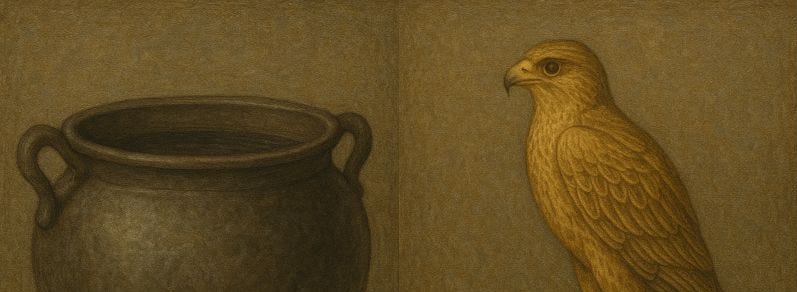
Ceridwen: The Yielding Mother of Welsh Mythology
Ceridwen tries to bend destiny to her will. She brews the cauldron of Awen for a year and a day, determined to craft a future in which her son’s perceived shortcomings would be erased. But when the magic spills into the hands of a servant boy, her carefully controlled world ruptures. She chased Gwion, the servant boy, transforming herself, revealing the raw ache of a mother trying to force an outcome that she believes is necessary for her child’s survival.
Yet the myth does not reward her control. It transforms it. When she finally swallows Gwion, the servant boy, and births him anew as Taliesin, she accepts a truth larger than her intention: surrender is the crucible of creation.
Frigg: The Yielding Mother of Norse Mythology
Frigg embodies the ache of a mother who tries to shield her child from every imaginable harm. She demands oaths from all things, fire, stone, metal, illness, believing vigilance and foresight can secure her son, Baldur’s, safety. But she overlooked mistletoe, a small and unassuming plant she deemed too insignificant to threaten him. When Baldur is killed by mistletoe, Frigg’s world collapses. Her grief is immeasurable.
The myth reveals a mother confronting the limits of even divine control. Her mourning becomes the hinge upon which the gods learn humility, interdependence, and the cost of trying to outwit what life delivers. In her acceptance, she becomes the embodiment of a deeper maternal truth: love cannot prevent loss; it can only hold what remains.
Symbols of the yielding mother
Molten gold: A metal made malleable by heat. It reminds us that softening is not collapse but the necessary state before reshaping.
Open hands: A posture of release. What she unclenches no longer controls her, and what remains is what was meant to stay.
Water: The element that dissolves what is rigid. It erodes cliffs, carries what is heavy, and teaches that yielding can shape the world.
Plant Ally for the Yielding Mother: Lemon Balm
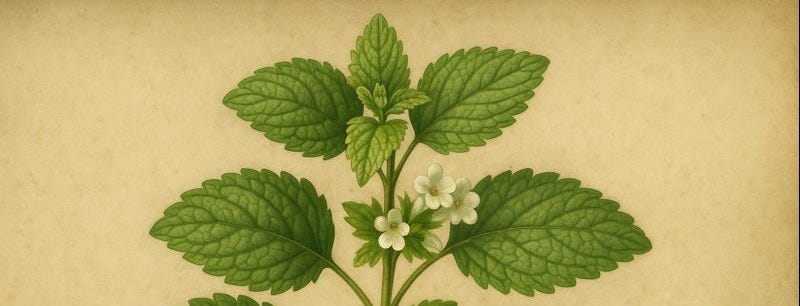
Lemon balm is a softener of the nervous system, an herb that invites the body down from its tightening, bracing, over-held places. It quiets the mind when it loops through worry, steadies a heart that has been gripping too tightly, and creates a gentle spaciousness around difficult emotions. It was used by our ancestors to calm restlessness, support sleep, and soothe the body when stress runs high.
It teaches what the yielding mother archetype teaches: that softening is not defeat. Lemon balm relaxes what is clenched, not to make a mother entirely passive, but to make room for clearer breath, steadier intuition, and the beginnings of acceptance. It helps dissolve the rigidity that comes from trying to control what cannot be controlled.
I relied on lemon balm during my postpartum time. A warm cup of lemon balm tea in the evening helped to settle my frazzled nervous system. A tincture before bed could also be used to ease mental gripping before bed. Even rubbing a fresh leaf between your fingers and breathing in its citrus scent can offer space for a deep, full-body exhale.
Lemon balm can remind us that softening is the beginning of change.
Ritual to support your yielding
Begin by naming the thing you are trying to hold together through sheer force: the outcome, the identity, the story, the fear. Write it down plainly, trying not to pass judgment. Let the truth of it sit in your hands.
When you’re ready, dissolve the paper in water or bury it in the earth. Let the elements take what your body has been holding onto. Release what cannot be controlled so that something more spacious can rise in its place.
Place one hand over your heart and one over your womb. Breathe slowly, letting your body feel the weight leave.
Prompts for Yielding
Where am I mistaking control for care?
What am I grieving that I haven’t named?
What could soften here?
What would trust feel like in my body?
The yielding mother is the one who survives initiation.
She learns that love cannot be enforced,
that bodies cannot be commanded,
that children arrive with destinies not her own.
When her grip loosens, something unexpected happens:
Life does not fall apart.
It reorganizes.
Yielding is the moment the cauldron spills.
The moment the spell breaks.
The moment creation begins.
This is the mother’s work,
not to control what emerges,
but to become someone who can live inside reality
without warring against it.
References
Beck, C. T. (2004). Birth trauma: In the eye of the beholder. Nursing Research, 53(1), 28–35.
https://doi.org/10.1097/00006199-200401000-00005
Borra, C., Iacovou, M., & Sevilla, A. (2015). New evidence on breastfeeding and postpartum depression: The importance of understanding women’s intentions. Maternal and Child Health Journal, 19(4), 897–907.
https://doi.org/10.1007/s10995-014-1591-z
Lee, E. (2008). Living with risk in the age of ‘intensive motherhood’: Maternal identity and infant feeding. Sociology, 42(3), 467–484.
https://doi.org/10.1177/0038038508088832
McBride, A. B. (1984). Becoming a mother: A life transition. Nursing Research, 33(6), 357–361.
Nelson, A. M. (2003). Transition to motherhood. Journal of Obstetric, Gynecologic & Neonatal Nursing, 32(4), 465–477.
https://doi.org/10.1177/0884217503255199
Raphael, D. (1975). The tender gift: Breastfeeding. New York, NY: Schocken Books.
Schmied, V., & Lupton, D. (2001). Blurring the boundaries: Breastfeeding and maternal subjectivity. Sociology of Health & Illness, 23(2), 234–250.
https://doi.org/10.1111/1467-9566.00249
Simkin, P. (1992). Just another day in a woman’s life? Women’s long-term perceptions of their first birth experience. Birth, 19(2), 64–81.
https://doi.org/10.1111/j.1523-536X.1992.tb00382.x
Winnicott, D. W. (1953). Transitional objects and transitional phenomena. International Journal of Psychoanalysis, 34, 89–97.
Winnicott, D. W. (1960). The theory of the parent–infant relationship. International Journal of Psychoanalysis, 41, 585–595.
The idea that we find survival in yielding rather than control is so powerful. It took me three babies to realize that my mind found its peace when I stopped trying to carry the weight of being 'in charge' of everything and just started being present in the flow. Such a soul nourishing read.
I really needed this. So beautifully rewritten. Thank you.