
The Selkie Bride
A Mother's Retelling

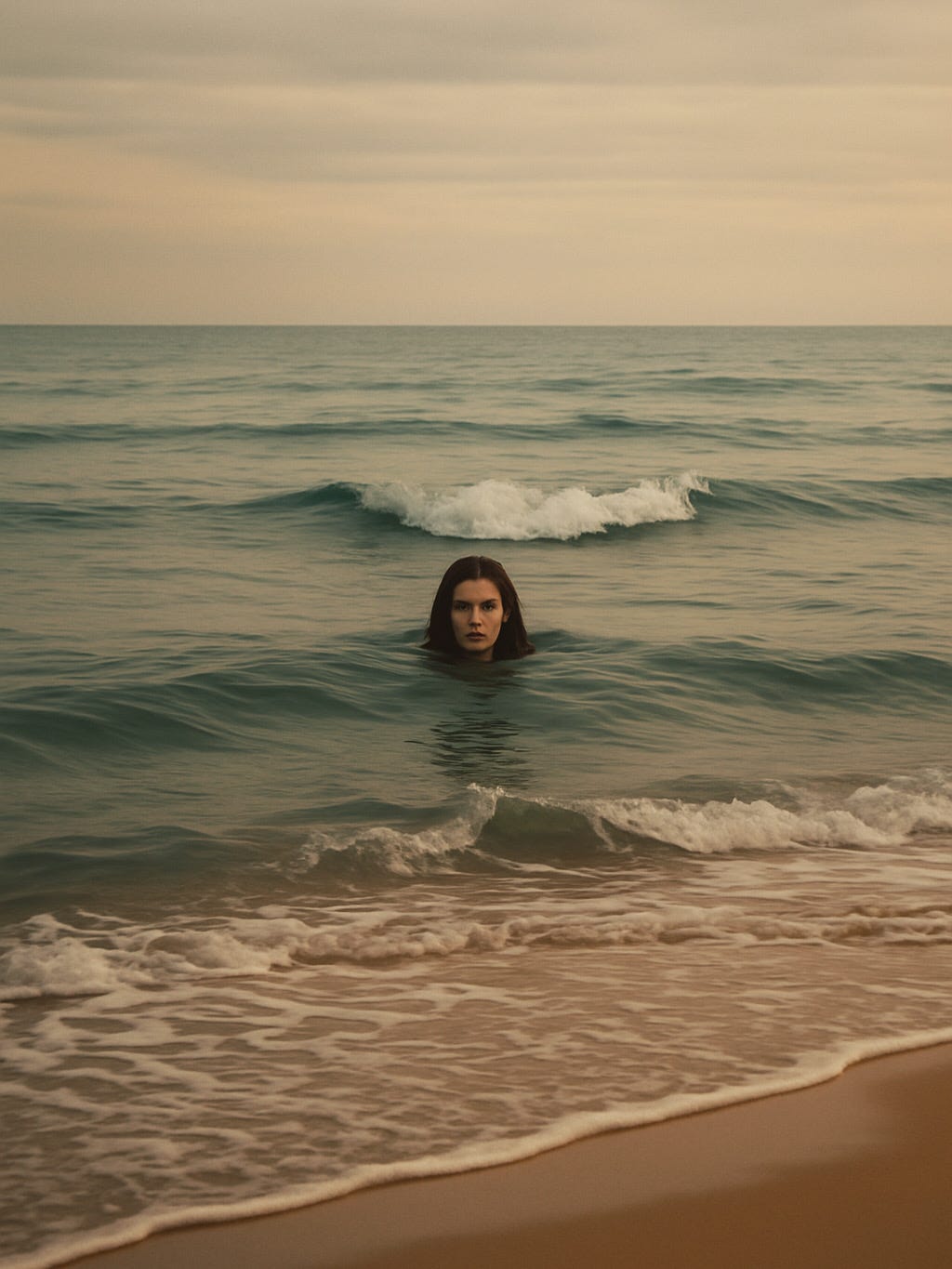
They say that on a windless, moonlit night, the sea opened its heart and let a woman rise from its depths. She slipped through the waves with her sealskin draped over her shoulder, shining like wet silk, unaware that there were eyes upon her. A lonely fisherman watched her emerge, struck still by the way her long dark hair clung to her moonlit skin, water sliding from her like spilled light. His first instinct was to call out — to ask if she needed help, for no one should swim alone at such an hour. But something within told him to wait, to watch.
He watched her climb onto black rocks in front of a mossy cove, setting her sealskin upon the rocks to dry. She was a Selkie woman, he realized - half woman, half seal - and she possessed a sorrowful kind of beauty that made his eyes linger. He quickly averted his eyes from her form, feeling as though he were trespassing on a moment meant for no human eye. But he remained there through the night, listening to her song until dawn softened the horizon with pale gold light. When the first light spread across the water, the selkie rose. Her hair fell like a cloak over her bare back as she wrapped herself in her sealskin and slipped beneath the waves once more.
Only then did the fisherman stumble home, dazed and aching with a hunger he could not name. He slept lightly and awoke uneasy: Had she been real?
By evening that day, he found himself walking to the same cove, driven by a pull as sure as the turning tide. Again, he hid behind the brush at the edge of the beach, moonlight lilting silver across the empty sea. Again, he waited until he had almost convinced himself she would not come.
It was not until the full moon rose high in the sky that the waves shifted again during his night vigil, a subtle ripple in their pattern, and the woman rose from the sea. Beads of saltwater traced her skin with a cold glimmer as she crossed the shoreline. He could do nothing but watch.
This continued for a fortnight, until the fisherman’s longing materialized into a thought he could not shake. Everyone on the islands grew up knowing that if you found a selkie’s skin, you could keep her. And everyone also knew that if you stole from the sea, the sea would eventually take its due. Despite the warning chilling his bones, he resolved that he would make the selkie his bride, whatever the cost.
That night, under a moonless sky, he waited. When her song rose over the waves, he crept toward the rocks where her sealskin lay drying. Moving with the hush of a man afraid of his own heartbeat, he seized the slick fur and slipped away into the darkness, hiding it deep in the brush.
When the selkie finished combing her hair and turned to find her skin, a keening grief tore from within her throat, the sound of a creature cut off from her world. The fisherman stepped forward then, leaving the stolen skin hidden behind him. She glared at him through tidal eyes, bright with fury. But when he asked if he might come closer, she gave a single, trembling nod.
“You are a selkie,” he said softly. “And it seems you’ve lost your tail. Come with me. Let me give you warmth, food, and shelter. Without your skin, you cannot return to the sea. You will die out here.”
She studied him, head tilted, suspicion sharp as a gull’s cry. Something in her recognized him as the thief, yet she also knew he spoke the truth. Without her sealskin, the land would wither her. So she nodded once more, allowing him to drape a wool blanket around her shoulders and lead her toward the soft glow of his hearth. He fed her, clothed her, offered her his home, and in time, she became his wife. She went willingly enough, but, all the same, a part of her remained behind with the sea that day.
At first, the selkie moved through her new life like someone stepping into a dream that was not her own. The fisherman’s cottage was warm and tidy, the rhythms of the days simple enough, yet everything felt slightly off. It was familiar in shape, but strange in feeling. But seasons passed, and something in her softened toward the fisherman. Affection grew the way tidewater gathers in a rockpool, slowly, unexpectedly, until it crests its edges and overflows.
Her womb quickened with his children. One son and two daughters came through her, each carrying the steely blue sea in their eyes. Her daily tasks, lighting the hearth, tending the little garden, nursing babies, brought her a quiet joy she hadn’t expected and had never dreamed of in her life at sea. There was sweetness in the repetition, a steadiness and fulfilment in the work of keeping a family alive.
One night, as she lay her babies to sleep in their beds, she sighed away the tensions of the day’s work. Her heart softened, filling with the sight of children’s peaceful faces and small chests rising and falling with the soft, sleepy breaths. Moments like these almost made her forget her life at sea. Almost. But there was a saltiness within her that would always make her feel like an outsider on land, no matter how much she had come to love this life. She kissed them each on their brow, lingering to smell the warm milky scent of their hair.
She closed the door with a creak and joined her husband by the light of the fire, curling into his lap while he stroked her hair. They sat together in the hush of evening until the flames dwindled and weariness tugged at their bones. The fisherman lifted her easily, carrying her to their bed with a tenderness he hoped could make up for the choice he had taken from her.
He did not regret taking her skin, but some nights the weight of it pressed on him. He blew out the candle and tried to quiet the unease that swirled like a whirlpool, tangling love and guilt together.
The next morning, he rose early and took the children with him to town. When the selkie woke, the cottage was empty, filled only with the faint smell of peat smoke and traces of child’s play. She set to her chores, planning to meet them later at the market in town. She gathered peat for the fire, swept the floorboards worn smooth by years of bootsteps and tiny bare feet, sorted the laundry, humming a familiar tune softly to herself.
As she shook out one of her husband’s shirts, something small and metallic slipped from its pocket and struck the floor with a delicate chime. It was a tiny golden key on a long chain. Her brow darkened as she turned it in her palm. He kept nothing locked from her, and there had never been any need for secrets between them... But one? The golden key glinted in her hand, setting fire to a curiousity she could not extinguish. She considered placing the key on his bedside table and returning to her work. But that same heat rose in her chest, and she could no more turn from it than she could turn from the pull of a riptide.
She searched the cabin, moving through every cupboard, every shelf, every forgotten corner. She found nothing. She decided to set the key aside and return to her work. But as she moved toward the hearth, the key slipped from her fingers, falling to the floor. This time, the sound was different. Not the chime of metal on wood, but a hollow sound, deep and muted.
The corners of her lips pressed downward as she crouched, pressing her ear to the boards. The wood was warm from years of fire, smooth beneath her hand. She tapped lightly. Hollow. She tapped again. Hollow. Her breath thinned as she slid her fingernails into the seam between two planks and pried gently. The board lifted with a soft groan, revealing a narrow cavity cut into the earth itself. Nestled inside lay a small wooden chest. Her heart stumbled a beat.
The key fit the lock with a single click. She lifted the lid and dropped it with a cry. There, neatly folded and waiting, lay her sealskin. Dry with years of age and time away from water, mottled in colour, but unmistakably hers. Betrayal stung her eyes. Rage surged through her limbs. She touched the fur with trembling fingers, remembering the feel of it against her slick body, the way it had once slipped through the water in the deep places. She knew the truth then: The fisherman had stolen her life long before he had given her another.
Yet beneath the fury was a grief she couldn’t place, echoing deep in the cavern of her heart. She knew that slipping on the skin would erase her memories of this life: the warmth of her children’s cheeks, the soft weight of their bodies, the sound of their small voices calling for her. Everything she had built on land would dissolve the moment she slipped her tail back on. The choice weighed on her, but her longing won her over in that moment.
Hands shaking, breath tight, she slipped the sealskin over her feet. A rush of relief rippled through her body. Fierce, wild, electric. Before she could think or steady herself, she was moving. The cottage blurred into unfamiliar shapes, her children’s wooden toys scattered on the floor like relics of another world. She slipped out the door and back toward her watery abode, the thundering waves beckoning her. The sea claimed her, just as the fisherman had claimed her those years ago.
There, she lived for a time, the life she lived on land forgotten. The currents remembered her. The tides welcomed her home. Old songs rose in her throat unbidden. But one day, as dusk’s hand began to close over the sky, she rounded the familiar rocky headland, and she stopped. A chill prickled over her spine, as cold as winter’s winds. There, playing on her beach, were a group of children. They were digging small holes, collecting shells, dipping their toes into the dark tidepools she had once loved.
Their carefree laughter carried over the water, tugging at her heart in a way that confused her. In that moment, her lost memories crashed back into her with the force of a breaking wave.
The fisherman’s home.
The warmth of their hearth.
The weight of tiny bodies curled against her chest.
The three small faces that had looked to her for everything.
A single briny tear stole down her hot cheek. The life she had lived on land reassembled inside her, piece by fragile piece, and the cost of reclaiming it cut through her with terrible clarity. For that moment, she stood between worlds - one made of saltwater, the other of tiny hands and milk. Neither would loosen its grip on her..
She hovered at the water’s edge, the wind biting her exposed skin. The children’s laughter drifted over to her, tugging at something familiar yet half-dreamed. She could only stay there - caught between two worlds.
Some stories say that she cast away her tail and returned to her children that day. Others say she swam the shoreline for years, singing a song only they could hear. But under the dark cloak of that night, the selkie chose. And whatever she chose, the sea kept part of her, and the land kept part of her, and she was never again entirely one thing or another again.
Myth Retelling. Source text: Dennison, W. T. (1880). The Orcadian sketch-book (2nd ed.). Kirkwall: William Peace & Son.
Your mom sent me your sustack very well written. Love it.
Amazing work, love that you’re putting these stories out into the world.