
Frigg's Tale
Beyond Control: What Frigg's Myth teaches us about the boundaries of a mother's control

Disclaimer: This myth includes the loss of a child.
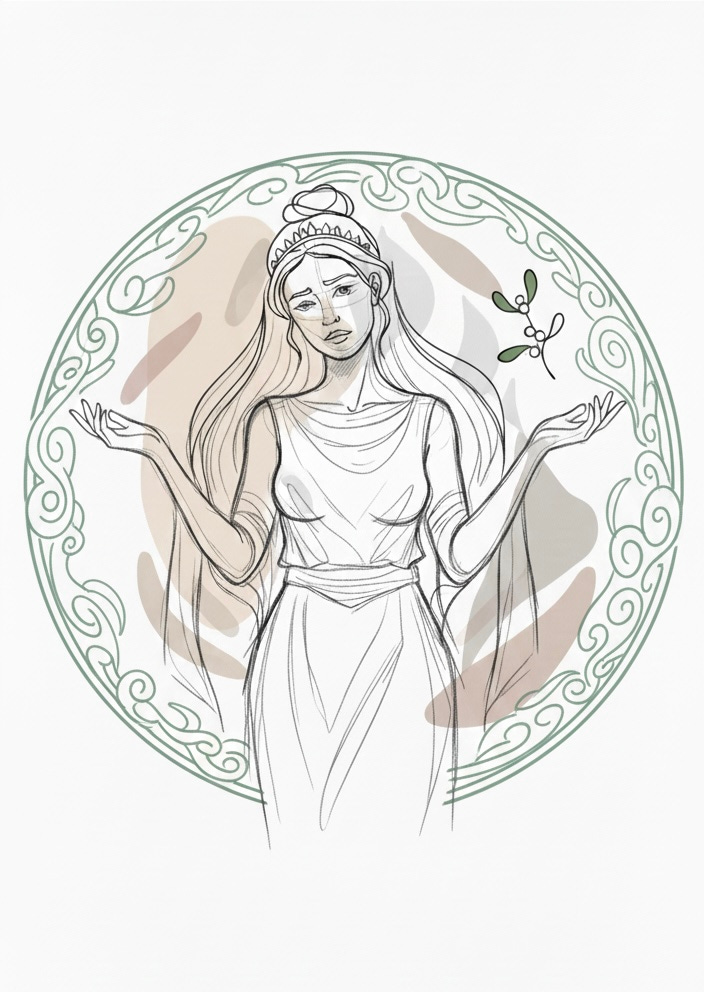
In the halls of the gods, there lived a mother with the gift of foresight. Frigg—queen of the Æsir, wife of Odin—was awake to what others were not. She did not speak of what she saw. Knowing did not grant her the power to change what was to come, only time to walk beside it.
When Frigg awoke one morning, something pulled her toward the gilded balcony of her bedchamber. She slipped on her golden slippers and stepped into the pale morning light. Below, her son Baldr—fairest and most loved of the gods—walked alone among the gardens, his pale face catching the morning’s gold. Frigg’s hand tightened on the balcony rail as she watched him pace below.
Baldr’s dreams had recently turned to nightmares of the most insidious kind. In his dreams, dark shapes skulked in the shadows, while something tore at his flesh, driving him forward into the abyss, always toward the same ending. Baldr woke with a cry, heard only by his mother in the deep hours of night.
Baldr’s dreams continued, and Frigg did not sleep. It was as though her wakefulness and vigilance might hold the world still, might keep him from harm. Something had been set into motion, but she could not find its edge.
Frigg and Baldr brought Baldr’s dreams to the Æsir, the council of gods and goddesses in Asgard. Frigg’s hands trembled as she spoke on her son’s behalf, letting the dread in her chest spill into the hall. Their heads nodded, and a murmur rose, and still no one met Frigg’s eyes.
In the following days, Frigg moved as though under a weight, while a fog settled over her mind. Her world suddenly narrowed to her son, and there it stayed. She trembled, buried by a feeling that something terrible was about to happen to him. The night terrors continued. Frigg’s body jolted upright with each cry. But when she rose, she felt the crushing weight of her helplessness, threatening to drown her, even as she stood upright.
One day, while she sat at her loom, allowing her fingers to work over the shining threads, a thought gripped her mind and refused to release her, even as the threads passed through her fingers and the loom kept its rhythm. She would bind the worlds against harming her son. Everything would swear not to harm Baldr. The Æsir agreed to Frigg’s quest. And so, she set out across the worlds to extract the oaths.
Fire swore an oath.
Water swore an oath.
And earth followed, heavy and slow.
As did iron and all kinds of metal, stones, trees, sicknesses, beasts, birds, serpents and venom.
Frigg did not stop to rest. Day and night, she laboured until all of the oaths had been collected. When the last oath was spoken, her body sagged with exhaustion, aching for rest. She returned to her home, laying in her bed until her strength returned.
When she awoke, the hall clamoured with joyful voices. The Æsir celebrated in the great hall, Gladsheim, with a feast and great horns overflowing with mead. Frigg’s brow brightened as she spied Baldr’s fair face from across the hall. He was standing, like a target against one wall, while other gods and goddesses hurled stones, sharpened sticks, and other objects at his still body. Frigg’s body stiffened. The objects fell away from Baldr’s body, leaving him unharmed. She released a long breath, though unease rose in her throat. Smoothing her golden hair, she joined Odin in celebration.
There was one who did not rejoice at Baldr’s apparent invincibility. Loki, the Sly One, watched Baldr with narrowed eyes, full of impatience. While the gods and goddesses celebrated Baldr, Loki slipped away, and the hall did not notice him go.
The next morning, Loki transformed himself into the shape of a weathered hag. She wandered into Frigg’s golden hall, Fensalir, bent-backed and painfully slow, faigning confusion.
Frigg’s voice echoed through the empty hall, “ You appear to be lost, old woman. This is Fensalir, the great hall of the goddess Frigg.”
The crone lifted a skeletal hand to scratch her wiry, grey hair, peering up at her through milky blue eyes.
“I have seen a strange thing,” she said. Frigg straightened in her chair. “I know the gods of Asgard to be good and fair. But, just now, I saw in the courtyard a fair man, white of face, golden of hair, who was struck by stones and did not fall. What crime earns such a game?”
Frigg laughed, the sound ringing silver through the hall. “It was my son, Baldr”, she said. “It was only a game. Fire has sworn an oath not to harm him. As well as water, earth, iron and all kinds of metal, stones, trees, sicknesses, beasts, birds, serpents and venom.” She finished.
The corner of the old woman’s mouth twitched upwards, a fleetingly mischievous tick. “Everything?”
“Everything…” Frigg paused. “I have brought the world to its knees for him. Everything except the small plant that grows west of Valhalla, mistletoe. I thought it far too young to ask an oath of.”
“It seems you have done your duty well.” The old woman grunted as she hobbled out of the hall.
Frigg sat in silence, the woman’s words settling slowly in her bones. As she replayed the stranger’s words in her mind, she felt something sinister stir within her, prickling the hairs at the nape of her neck.
Once she was certain to be out of sight, the hag fell away. The trickster, Loki, reemerged with a great, sinister smile from ear to ear.
Under a starless sky, Loki went west. The plain of Idavoll opened before him as he loped forward. Eventually, the Sly One came upon a forest and began looking for mistletoe, first under his feet and then high into the thick spiderweb of branches.
Pink morning light crested over the horizon, spilling over the wood. High in the skeletal fingers of an ancient oak tree, a cluster of mistletoe hung, a tangle of leathery green leaves and waxy white berries. Loki almost mistook the young plant for a bird’s nest, but the milky, unblinking eyes of mistletoe were unmistakable, even in the low light. Quick as a Hermod, Loki plucked the youngling from its branch and vanished back into the shadows, back to Asgard.
Frigg’s sleep remained fretful. Fear moved through her mind in the dark hours, stealing from the wellspring of her vitality. Despite the gift of foresight, Frigg’s mind was cloudy, full of doubt. She stood again at the darkened balcony, searching the night for what would not show itself, knowing it waited just beyond her sight. Her heavy breath puffed up into the air, and she felt the cool caress her hot, dewy brow. She felt a wave of despair pull her down, drowning her. Yet, she could do nothing about it.
The next morning, Hödr, the blind god and son of Frigg, sat in the courtyard, sunning himself, staring up at the swaying trees as though he could see their dance. Away, across the gardens, Loki watched Hödr carefully, waiting for his moment to approach, when there were no prying eyes to observe his mischief. He slowly slunk forward, pleased that the gods and goddesses were distracted by their game of tossing stones and sticks at Baldr. Loki stepped close, his shadow cutting Hödr off from the sun, and lingering there.
“Who approaches?” Hödr said without flinching away from Loki’s imposing presence. “I know who you are. You can be none other than Loki. What is it that you need?” He asked a moment later, slightly annoyed by the interruption.
“None other. I noticed that all of the gods and goddesses in Asgard are testing your brother’s immunity, but you. Why do you not join them?” The trickster asked in a voice honeyed with innocence.
“Because I cannot see where Baldr is, and I am weaponless anyway.” Hödr slid his arm back under his head, closing his unseeing eyes.
However, Loki did not move, continuing to eclipse the sun over Hödr’s face.
“I believe I could help you with that, dear Hödr. Your blindness should not stop you from participating. Take your place.” Loki stated matter-of-factly.
Hödr considered for a moment. Then, slowly, he asked, “You would do that for me, Loki? You would help me take part in my brother’s game?”
Hödr could not see, but Loki’s wolfish smile crested to a peak, revealing a set of gleaming white teeth.
“Of course I would! I am also often left out of the revelry of the gods. I will take you to your brother and arm you with a weapon.”
Hödr agreed to Loki’s offer. Together, they crossed the green gardens, crossed the radiant courtyard, and slipped into Odin’s hall, where a commotion stirred the air. Loki guided the blind through the unsuspecting crowd to a spot where he could easily hit his target. Slipping the mistletoe from his cloak, Loki pressed the mistletoe into Hödr’s hand and guided his arm.
“Shoot, now!” Loki whispered in Hödr’s ear. Hödr obeyed, shooting the mistletoe at his brother’s chest.
The shaft of the mistletoe struck Baldr’s chest as he clutched it. He looked toward his brother, then fell sideways onto the hard ground. Baldr did not rise.
Silence.
And then a wail rose out from the back of the crowd.
It echoed through all nine worlds.
Frigg flung her body through the crowd, as it parted for her like a tide. She gathered his limp body, smoothing his golden hair, whispering into deaf ears.
In the echo of Frigg’s keening, all of the nine worlds broke out in weeping. Odin cried for his son. He proclaimed this moment to be the greatest mischance that has ever befallen among gods and men.
Frigg did not let her son go. She held him, swaying back and forth, believing her arms might keep him. He left her, nevertheless. She felt the moment he left her, taken by a power beyond her reach. In that moment, the colour drained from the world and did not return.
Frigg wept and wept, and the worlds wept with her. She went to the Æsir with a plea to send someone to retrieve Baldr.
Hermod the Bold, son of Odin, rose, already armed and ready for the perilous journey to Hel. “I will go.” He declared. “I am ready.”
And so it was. Hermod mounted Odin’s mighty eight-legged horse, Sleipnir, and departed, hoofs clattering on the marble floor as he rode.
Weeks passed, and Frigg wept her way through them. She wept long past Baldr’s cremation, and that of his wife, Nanna, who followed him into death.
No one could take vengeance upon Baldr and Nanna’s deaths. The Æsir knew Hödr had been tricked, for the god was blind. But the culprit remained unknown. Frigg blamed herself for the oath that had been left unspoken. She would not rise from her bed. Food turned to ash in her mouth. Sleep would not find her as her pulse circulated a poisonous grief. Then Hermod returned, bringing tidings to the Æsir of Baldr.
Hermod begged Hel for Baldr’s return. Hel answered: she would release him only if all things in all of the worlds would weep for Baldr.
Colour returned to Frigg’s face, and something like hope moved within her. She crossed the worlds again, asking all things that had sworn an oath to her to weep.
Fire wept.
Water wept.
Earth followed, heavy and slow.
As did iron and all kinds of metal, stones, trees, sicknesses, beasts, birds, serpents and venom.
On her way home, Frigg approached a lonely cave. There was something within. Frigg knew she had to stop. She dismounted her chariot and peered through the gloom of the slick cave walls.
She heard breathing. A deep, low hum. It could be none other than a giant in there.
Frigg swallowed, closed her eyes, and found her courage. She entered the cave, tiptoeing on silver slippers across a thick layer of slime. As she rounded the corner of the cave, she saw a great giantess sleeping in the corner. Her heart sank.
Frigg cleared her throat. “Giantess, what is your name?”
One yellow eye opened, and then another. The giantess turned her great head towards Frigg, a permanent scowl etched into her grey skin. She did not move when she saw the golden goddess before her, and simply grumbled, “Thok.”
Frigg explained her mission and asked Thokk to weep for her lost son, for she was the last being in all of the worlds to do so. Frigg’s voice was thickened as she spoke. Thokk did not stir.
Once Frigg had finished, Thokk wore a twisted grin. “I will weep dry tears,” Thokk said. “Hel may keep him.” When the last of her deep voice faded from the cave walls, she closed her eyes once more. She did not open her eyes again.
Frigg understood before she left the cave. She left, and Baldr did not follow her home.
When word reached the gods that one being alone had refused to weep, suspicion turned quickly toward Loki. The name Thokk circled the halls, then settled into a knowing silence. The trickster did not deny it when he was seized. Loki laughed when they bound him.
For his crime, Loki was bound beneath the earth. A serpent was set above him, its venom dripping steadily onto his face. Sigyn, his wife, knelt beside him with a bowl to catch the poison, emptying it when it filled. Each time she turned away, the venom struck Loki’s skin, and his convulsions were said to shake the world.
Still, Baldr could not return.
The worlds, having wept, grew quiet again. Fire burned. Water flowed. Stone kept its weight. Nothing was undone by grief.
Frigg carried her sorrow back into the halls of the gods. Where once she kept foresight, she now remained with what had come to pass.
And though Baldr remained in Hel, and Frigg among the living, she carried her son’s memory with her.
Bibliography
Davidson, H. R. E. (1964). Gods and myths of Northern Europe. Oxford University Press.
https://archive.org/details/godsmythsofnorth0000davi/page/30/mode/2up
Lindow, J. (2001). Norse mythology: A guide to the gods, heroes, rituals, and beliefs. Oxford University Press.
Snorri Sturluson. (1916). The Prose Edda (A. G. Brodeur, Trans.). American-Scandinavian Foundation. (Original work composed c. 1220)
https://archive.org/details/proseedda00snor/page/76/mode/2up
The Poetic Edda. (2014). In C. Larrington (Trans.), The Poetic Edda. Oxford University Press. (Original poems composed c. 9th–13th centuries)
Absolutely brilliant ❤️ 🙏
Amazing writing as always !!