
Death in a Nut
A Mother's Retelling of a Scottish Tale on Raising Children and Letting Go

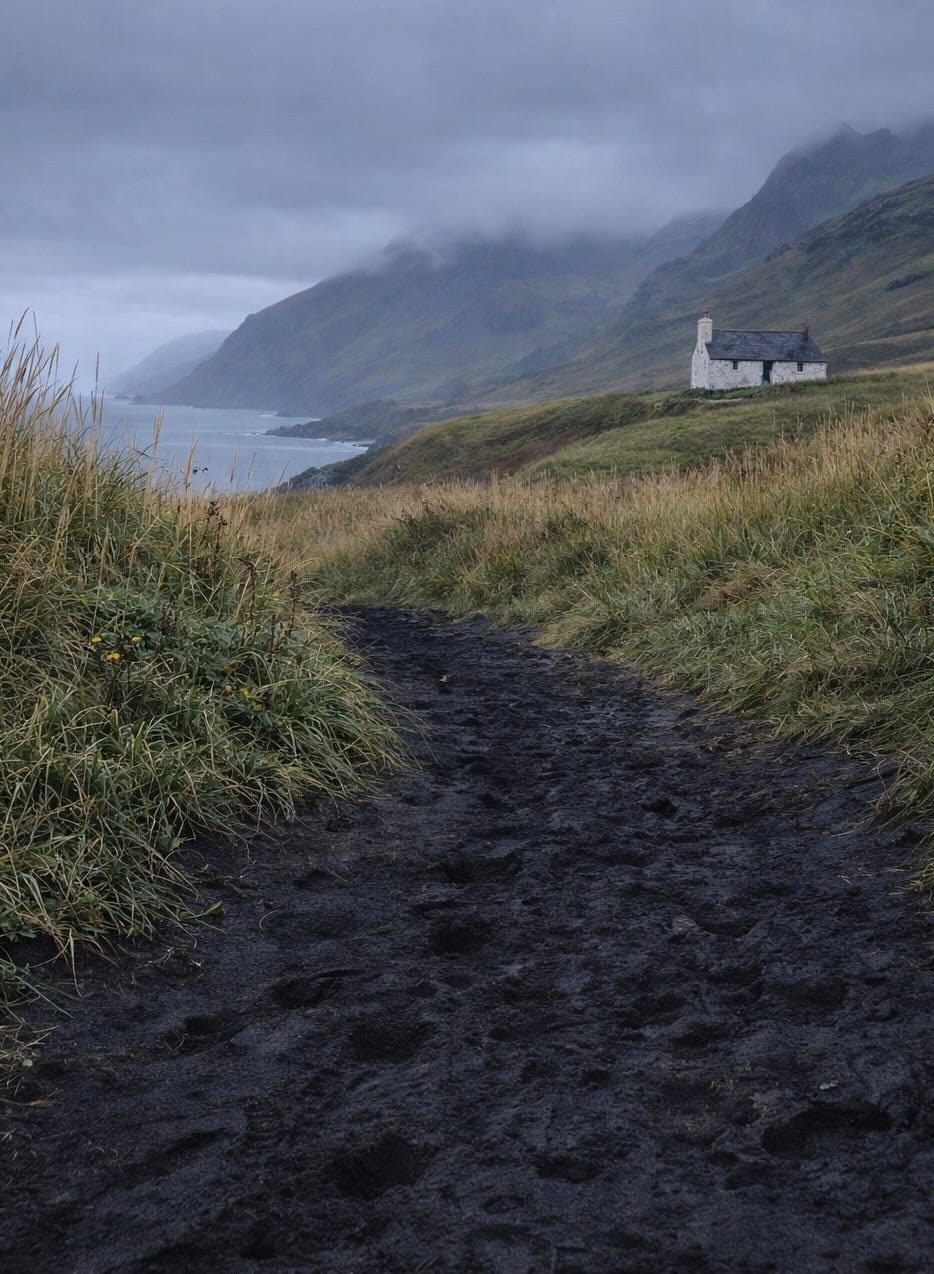
You can listen to the story below or read on.
There once was a mother who lived with her son in a small croft along the western coast of Scotland, where the stormy sea pressed its salt-crusted will against the marrow of the land. It had been just the two of them, since the day Jack’s father was claimed by the grey-blue depths. Since then, the world became a narrow, circular thing. Comfortable, but limited. Everything the boy knew of it passed through Flora’s hard-working hands.
Every morning, they set out together to work the land. Jack cut the hay for the goats, milked the cow, pulled the vegetables from the earth, and always made sure there was wood to feed the fire. Flora watched her son as he worked. She saw her own restlessness in him - in the way the cottage walls made him itch, in the way his gaze wandered out to the horizon. She knew that this small world they lived in together would not be enough to keep him.
The thought left her strangely empty. Jack was her centre of gravity. She felt that without him, she would simply float away with the morning mist. A sad smile crept at the corner of her dry lips, standing at the edge of a life that would inevitably outgrow her.
Before the morning’s work, Jack made a habit of wandering out to the seaside, inventing stories about adventure, turning over rocks, and picking up twisted pieces of driftwood, smoothed by the relentless grey-blue sea. The boy always brought some treasures home for his mother, who kept every piece. She had quite the collection, now that her son was nearly a man.
One January morning, the cold came off the sea and settled into his bones before he reached the roaring shoreline. The salty-wet wind coiled tightly around his limbs, numbing them as he walked. He had left before his mother woke, wearing only a now soggy woollen sweater that did little to shield him from the moods of the sea. But Jack could see blue breaking through in the distance.
As Jack rounded the land bend before the sandy beach, he spied a figure walking along the shoreline. Strange. He had seldom seen anyone out this early, and definitely never in a storm. The figure drew closer, and Jack could see that he was an old man in a ragged black cloak, with a long grey beard, tangled like nets pulled from the tide. His eyes widened, travelling up and down the bent man, as he saw there, on the man’s back, was a scythe. And it wasn’t harvest time any longer.
The boy’s heart thundered, yet his body stiffened, failing to obey his commands to move, to run, to do something. Shivers prickled the back of his neck, and a bead of cold sweat dripped down his rain-slick skin. As the stranger approached, Jack could make out the man’s sunken eyes, like two great black hollows that opened between worlds. The boy’s throat bobbed as he stood there.
He knew him then. It was Death.
Jack’s throat tightened. Mother! A knowing struck sharp and sudden, like the shrieking of the gulls circling overhead. His mother had the sniffles and had not been feeling well as of late, but surely she was not ready to die.
Light caught the scythe blade as the clouds broke, the glittering of the morning sun, now peaking through in soft waves of gold and silver.
“Good day, young lad.” The old man’s thin voice stole the air from Jack’s lungs. “Can ye tell me where the next cottage is? There’s someone there I’d like to visit.”
“My - my ma lives just down the shoreline a bit. Just down there, in the next cottage.”
“Aye,” Death’s voice drew deeper. “That’ll be her that I’ve come to pay a visit then.”
Jack moved. He leapt at Death, forcing him down into the wet sandy soil, muscles bulging to subdue the oddly strong old man. They struggled, sand grinding into skin, breath ripping from his thundering chest. And then Jack noticed something. With each blow, the old man grew smaller. Smaller and then smaller still he grew, until he fit in Jack’s trembling palm.
Jack looked around, stunned. He wondered what he had done, and what he should do now with this tiny Death. The sea behind him had gone as still as blue glass.
He found his hand in the pocket of his rain-soaked breeches. It rummaged around until it brushed against something hard and smooth. He rolled it between his fingers. A hazelnut shell. Jack plucked Death from one palm, packed him into the shell’s hollow, and pressed it tightly shut.
Jack’s pulse travelled out of his ears and back into his chest. Relief washed over him as terror receded, steady as the tide washing over his bare toes. Jack looked down at his feet and saw that Death’s scythe lay half-buried in the sand. He buried the scythe deep, hurled the nut into the sea, and then turned towards home, back to his mother.
Smoke rose from the chimney in sweet woody drifts into the clearing sky. Jack knew then that his mother was already up. He took the wooden steps leading up to the cottage two at a time and pushed through the door. Jack fell into his mother’s arms, like he was a little boy again.
Flora was baking scones for breakfast. When her son embraced her, a cloud of flour from her dusty apron erupted in front of her, creating a great mist that hung over the kitchen in the golden light beaming now through the kitchen window.
“Ma—how are ye? Ye’re up… ye’re feelin’ better, aye? Ye’re up so early, I haven’t even made ye tea yet.”
Flora smiled and held his urgency for her a moment longer than she meant to. She kissed her son’s rosy cheeks.
“Aye, laddie. I’m well enough this mornin’. Better than I’ve been in years.” And it wasn’t a word of a lie, she had woken feeling better than she had in decades. “Go on now, get out of those wet clothes. And fetch a few eggs while ye’re at it. We’ll have them with the scones.”
Jack left her at the table, hands deep in flour, working the dough until it was just right. He returned with four large speckled hens’ eggs and fetched the frying pan to place over the open fire. He set the pan over the fire and dropped in a spoon of fat. Flora watched as he took the eggs in hand and tried to crack them one by one into the pan.
Crack. Crack. CRACK.
Jack stuck them against the pan, against the stone, and even hit them with a hammer. And yet, the eggs would not break.
Strange… Had the hens laid bad eggs?
Jack went back outside and returned with some duck eggs. But when he tried to crack them, they too would not break.
“Laddie, go on and fetch us some roots from the cellar.” Flora looked sideways at the unbroken shells in the basket, as Jack did as his mother bade.
Jack came back with a few leeks, some carrots and a parsnip. He set them down on a block and found the sharpest knife in the house. But to her dismay, Flora watched as the blade skated over the skins as though they were stone.
Zzzzhhh. Zzzzhhh. Zzzzzhhhhhhh!
“Did ye pick the frozen vegetables again, lad? I tol’ ye that ye needed te check…”
“No, ma! There’s been no frost—none at all!”
Flora’s stomach sank with her appetite for breakfast; she knew that he was right. A growing boy needed to eat, though.
“Go on to the butcher, then. See what he has.”
Flora set out to her daily chores while Jack went into town. When she stepped out to the garden, she froze, dropping the basketful of eggs she had collected, which lay unbroken on the dewy ground. Where the winter ground had lain asleep with a few sprouts here and there the day before, a thick green moss crawled over the earth. Thousands. No, Millions of bright green Caterpillars, thick as the eye could follow, feeding on the last of their crop without end. Shovel in her trembling hand, Flora imagined herself squashing every last insect until they were a pulp. But something stayed her hand.
A tear slipped down her winter’s blush. She understood now. Although she had no idea how it had happened, nor what they could do about it. Flora sat on the earth and watched the caterpillars take what was left.
Jack returned running, breathless from his quarter-mile sprint.
“The butcher canna cut his meat, ma! Not a blade will take it… Somethin’s gone wrong—terribly wrong! Nothing will die, ma—nothing!” He paused. “All the townsfolk are talkin’ about it—none can eat, none can break a thing. Nobody can even eat an apple… Oh, ma! What are we going to do?”
Flora could see a wetness forming at the corner of her son’s glassy storm-blue eyes. Though he may not have placed the pieces together in that moment, she could see a glint of remorse in their depths, and she knew in that moment that he would tell her the truth of it.
She reached for one of his cool, clammy palms and closed her warm, steady hands around his.
“Why, laddie? Why d’ye think this is happenin’?”
Jack went still, gaze downcast at the uneven wooden floorboards. Then he looked at her, knowing passing between them.
“Ma, it’s all my fault.”
“Your fault, laddie?”
“Ay, mother. It was me.” And the story flowed from him in broken pieces punctuated by the lump in his dry throat. “And now there’s naught to be done... He’s lost to the sea— But ma, I’d sooner starve all the days than lose ye. I would.”
“Jack…” She paused, her voice deepened, “It’s Death that keeps the world alive. We canna do without him.”
“What d’ye mean, keeps the world alive? He’d have taken ye if I hadn’t trapped him! You’d be dead! I’m no ready for ye to die, ma… Not ready at all!”
He pressed his head back in Flora’s shoulder, and she held him, breathing in the closeness, for she knew what came next would not be easy.
“Aye. I would have gone, Jack, you’ve got the right of it. But the world would still be turnin’, wouldn’t it? And folk would be eatin’, livin’. Now they’re starvin’, all for the sake of keepin’ me here for ye. Without Death, nothin’ thrives. Life needs Death, and ye’ll need te let me go, laddie.” Flora could see the strike of her words on her son’s cheeks. “Ye know what ye must do… Ye know the shore better than any. Ye’re the best beachcomber there is. If Death can be found, it’ll be ye that finds him. And when ye do… ye know what’s to be done.”
The next morning, Jack returned to the shore. He walked for miles, his stomach gnawing at him as he went. He found shells and fragments the tide had brought in, things he once would have taken home, as well as some of the purple-veined spiral shells his mother loved. He even found Death’s scythe and stored it in a nearby sea cave. Yet, there was no sign of the nut.
But everyone around was suffering. The fields lay thin. The cattle stood hollowed at the ribs. Even the gulls seemed to have lost their desire to fly. The world was a still pool. Stagnant, like a currentless ocean. Still, Jack searched.
When he returned home that day, his mother sat by the window, and he noticed her linen shift hanging loose from her frame. He said nothing as he retreated into his room.
For two more days, he walked the shore. Jack’s movements slowed as though the stillness had seeped into his bones. On the third morning, he woke from a fevered dream. In his dream, Death’s nut had floated so far out to sea that it had landed on the distant shores of another world.
“What’ve I done? I’ll never find it… never…” Jack lay there, unmoving. But the promise he made to his mother to keep searching lifted him from his resting place and led him out and onto the path to the shoreline.
Jack looked all day, again, with nothing to show for it. The winter light thinned towards dusk’s gasping mouth, spilling silver across the watery horizon. Jack collapsed onto the sand and looked down at his dry palms, admitting defeat. As he looked down between his hands, something caught his eye, however. Something… smooth and brown and all too similar.
“No…” He breathed. “It canna be!”
Jack dug into the sand and plucked a salty hazelnut from the muck. Relief rose in him and then faltered. Jack knew what opening the nut would cost him. But he also knew the cost of subduing death. He opened the nut, releasing Death from his prison.
Death flew out of the shell, rising to his former stature, looking over the thin and weathered boy sitting in the sand.
“Ye thought ye could keep me, did ye, lad? You thought you could keep me in there forever, and that would be the end? Well, Jack, you have much to learn. Without me, nothing lives…”
Jack kept his eyes down, bowing his head to Death.
“Aye. I know it now. I’m sorry I trapped you. It was wrong.” His gaze rose back up to the old man with the sunken eyes and long, ragged coat. He looked just as he did before.
“Aye. Ye understand some things now. That was well done, settin’ me free.”
“I know.. And I know why ye’ve come. But… will ye grant me one thing?”
Death paused, looking down at the young lad with an impenetrable expression.
“Let me come wi’ ye. Jus’ to see her… Just once more. I’ll even give ye your scythe back. I’ve kept it safe fer ye.”
Death inclined his head as Jack led him to his scythe in the sea cave and then along the windswept path back to the cottage. The sky had darkened. The storm was coming in from the sea. Jack shivered, opened the door for Death.
There, his mother sat again by the window, staring out at the garden. Jack noticed how cold the house was now, as Death crossed the threshold.
Flora looked up, and the fog in her eyes cleared as she saw her son and the stranger.
“Ye did what ye had to, son.” Her voice was honey on sour gooseberries.
“Good to see ye again, Flora.” Death breathed in his icy voice. “I see your son, he’s… Come to understand somethin’s. But he still has much to learn. I’ve others to see in the village now…” He paused, looking down at the boy once more. “I’ll come again, lad. ” Death stepped back across the threshold and into the screeching winter storm.
Jack stood in the doorway a long while after, eyes following the ghostly footsteps of Death. The wind passed through the open door. Behind him, Flora took a long breath in and then out.
Retelling source - Duncan Williamson’s Death in a Nut: https://www.gla.ac.uk/media/Media_1209461_smxx.pdf
Amazing writing, really love how you brought this important and valuable lessons to light.